If you’re spending Thanksgiving with Spanish-speaking family, coworkers, or neighbors this year, a “Happy Thanksgiving” in Spanish goes a long way. It’s also one of those phrases that gets mangled a lot, so here’s the right way to say it, how to pronounce it, and a bunch of other phrases you can use around the table.
Thanksgiving 2026 is Thursday, November 26. Here’s everything you need to wish someone a happy Thanksgiving in Spanish.
How to Say Happy Thanksgiving in Spanish
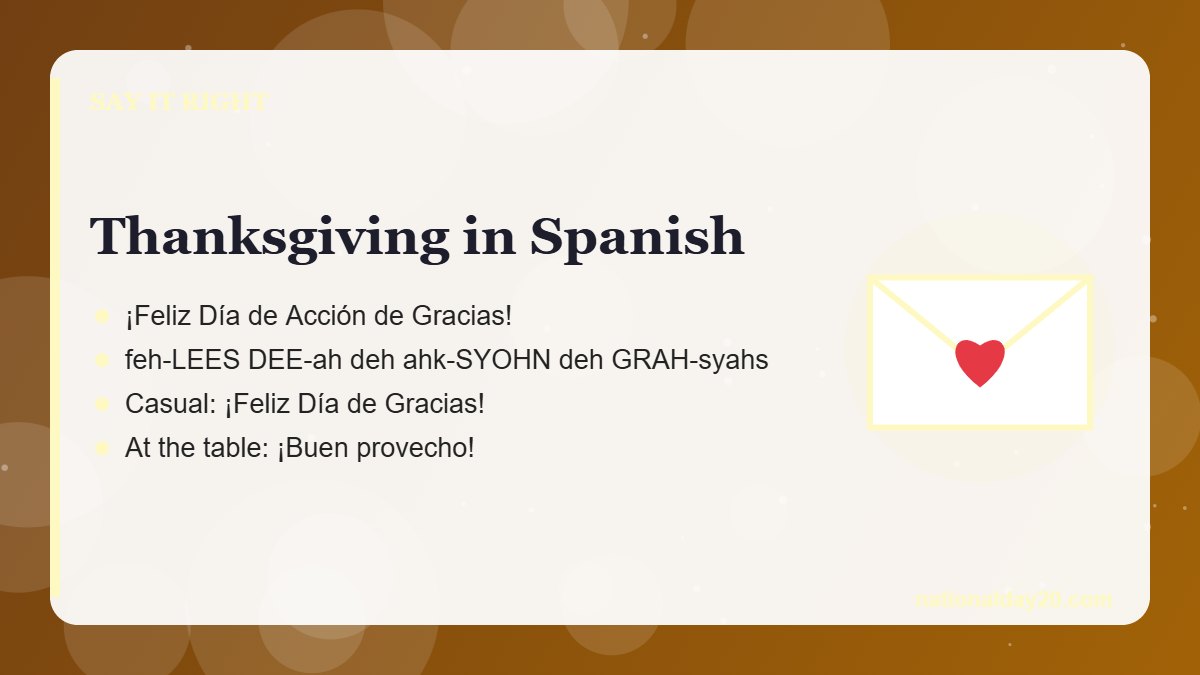
The most common and correct way to say Happy Thanksgiving in Spanish is:
¡Feliz Día de Acción de Gracias!
Pronounced: feh-LEES DEE-ah deh ahk-SYOHN deh GRAH-syahs
Literally, it means “Happy Day of Giving Thanks.” Thanksgiving itself is el Día de Acción de Gracias.
You’ll also hear a few other ways to say happy Thanksgiving in Spanish:
| Spanish | Pronunciation | When to use it |
|---|---|---|
| ¡Feliz Día de Acción de Gracias! | feh-LEES DEE-ah deh ahk-SYOHN deh GRAH-syahs | The standard, works everywhere |
| ¡Feliz Día de Gracias! | feh-LEES DEE-ah deh GRAH-syahs | Shorter and casual |
| ¡Feliz Thanksgiving! | feh-LEES THANKS-giv-ing | Very common among Latinos in the U.S. |
| ¡Felices fiestas de Acción de Gracias! | feh-LEE-sehs fee-EHS-tahs… | Festive, a bit more formal |
Honestly, “¡Feliz Thanksgiving!” is what a lot of bilingual families in Texas, California, Florida, and New York actually say. It’s not wrong. It’s Spanglish, and it’s perfectly friendly. But if you’re writing a card to someone who speaks mostly Spanish, go with the full version.
Pronunciation Tips
Getting happy Thanksgiving in Spanish right mostly comes down to three words:
- Feliz: stress the second syllable, “feh-LEES.” The z sounds like an s in Latin America.
- Acción: the double c sounds like “ks,” so “ahk-SYOHN.” In Spain, it’s closer to “ahk-THYOHN.”
- Gracias: “GRAH-syahs” in Latin America, “GRAH-thyahs” in much of Spain.
Happy Thanksgiving in Spanish: Wishes and Messages
Want to say more than happy Thanksgiving in Spanish? Here are Thanksgiving messages in Spanish with English translations. Use tú forms for friends and family and usted forms for people you’d address formally, like a boss or an older neighbor.
| Spanish | English |
|---|---|
| Te deseo un feliz Día de Acción de Gracias. | I wish you a happy Thanksgiving. |
| Le deseo a usted y a su familia un feliz Día de Acción de Gracias. | I wish you and your family a happy Thanksgiving. (formal) |
| Les deseo a todos un feliz Día de Acción de Gracias. | I wish you all a happy Thanksgiving. |
| Doy gracias por tenerte en mi vida. | I’m thankful to have you in my life. |
| Estoy muy agradecido por ti. (agradecida, if you’re a woman) | I’m very thankful for you. |
| Que tengas un día lleno de amor, familia y buena comida. | Have a day full of love, family, and good food. |
| Gracias por todo lo que haces por nosotros. | Thank you for everything you do for us. |
| Hoy y siempre, doy gracias por mi familia. | Today and always, I give thanks for my family. |
| ¡Feliz Día de Acción de Gracias, mamá! Te quiero mucho. | Happy Thanksgiving, Mom! I love you so much. |
| Que Dios bendiga tu hogar este Día de Acción de Gracias. | May God bless your home this Thanksgiving. |
If you’d like more ideas in English that you can translate, check out our full list of Thanksgiving wishes and our Thanksgiving quotes.
Thanksgiving Food Words in Spanish
Once you know how to say happy Thanksgiving in Spanish, the food words are next. Hosting Spanish-speaking guests or helping in a bilingual kitchen? These words will come in handy. Some vary by country, so I’ve noted the common options.
| English | Spanish |
|---|---|
| Turkey | el pavo (also el guajolote in Mexico) |
| Stuffing | el relleno |
| Mashed potatoes | el puré de papas (puré de patatas in Spain) |
| Gravy | la salsa (many U.S. Latinos just say “el gravy”) |
| Cranberry sauce | la salsa de arándanos |
| Sweet potatoes | los camotes (Mexico) or las batatas |
| Corn | el maíz, or el elote for corn on the cob in Mexico |
| Green beans | los ejotes (Mexico) or las judías verdes |
| Pumpkin pie | el pastel de calabaza (el pay de calabaza in Mexico) |
| Leftovers | las sobras |
| Dinner | la cena |
| Parade | el desfile |
And at the table, don’t forget ¡Buen provecho! (bwehn proh-BEH-choh), which means “enjoy your meal.”
A Short Thanksgiving Prayer in Spanish
This simple blessing is said before meals in many Catholic homes across Latin America:
Bendícenos, Señor, y bendice estos alimentos que por tu bondad vamos a recibir. Por Cristo nuestro Señor. Amén.
English: Bless us, O Lord, and bless these gifts which we are about to receive from your goodness. Through Christ our Lord. Amen.
Do Spanish-Speaking Countries Celebrate Thanksgiving?
Mostly, no. Thanksgiving is an American holiday, and Spain and most of Latin America don’t have an equivalent national day. There are a few exceptions worth knowing:
- Puerto Rico celebrates Thanksgiving as an official holiday, since it’s a U.S. territory. A local favorite is pavochón, a turkey seasoned like Puerto Rican roast pork (lechón).
- Mexico doesn’t have an official Thanksgiving, but some families, especially near the U.S. border or with relatives in the States, have adopted the tradition.
- Latino families in the U.S. celebrate Thanksgiving with a mix of traditions. It’s common to see tamales, arroz con gandules, pernil, or mole right next to the turkey.
The U.S. holiday itself dates back to George Washington’s 1789 proclamation and was fixed to the fourth Thursday of November in 1941, according to the National Archives.
Frequently Asked Questions
How do you say Happy Thanksgiving in Spanish?
Say “¡Feliz Día de Acción de Gracias!” (feh-LEES DEE-ah deh ahk-SYOHN deh GRAH-syahs). A shorter, casual option is “¡Feliz Día de Gracias!”
Is it okay to say “Feliz Thanksgiving”?
Yes. “¡Feliz Thanksgiving!” is common among Spanish speakers in the United States and sounds friendly and natural.
What is Thanksgiving called in Spanish?
Thanksgiving is called “el Día de Acción de Gracias” in Spanish.
How do you say “I’m thankful for you” in Spanish?
“Estoy agradecido por ti” if you’re a man, or “Estoy agradecida por ti” if you’re a woman. “Doy gracias por ti” works for anyone.
