Is Christmas a pagan holiday? Short answer: no, but “pagan Christmas” isn’t a made-up idea either. Christmas started as a Christian celebration of Jesus’ birth. Over the centuries, though, it picked up customs from Roman winter festivals and northern European traditions. That’s why you’ll hear people argue about it every December.
Here’s the real history of pagan Christmas customs, without the internet hot takes.
Where Did Christmas Come From?
The Bible never says when Jesus was born. The gospels don’t give a date, and early Christians didn’t really celebrate birthdays. For the first few centuries, Easter was the big holiday.
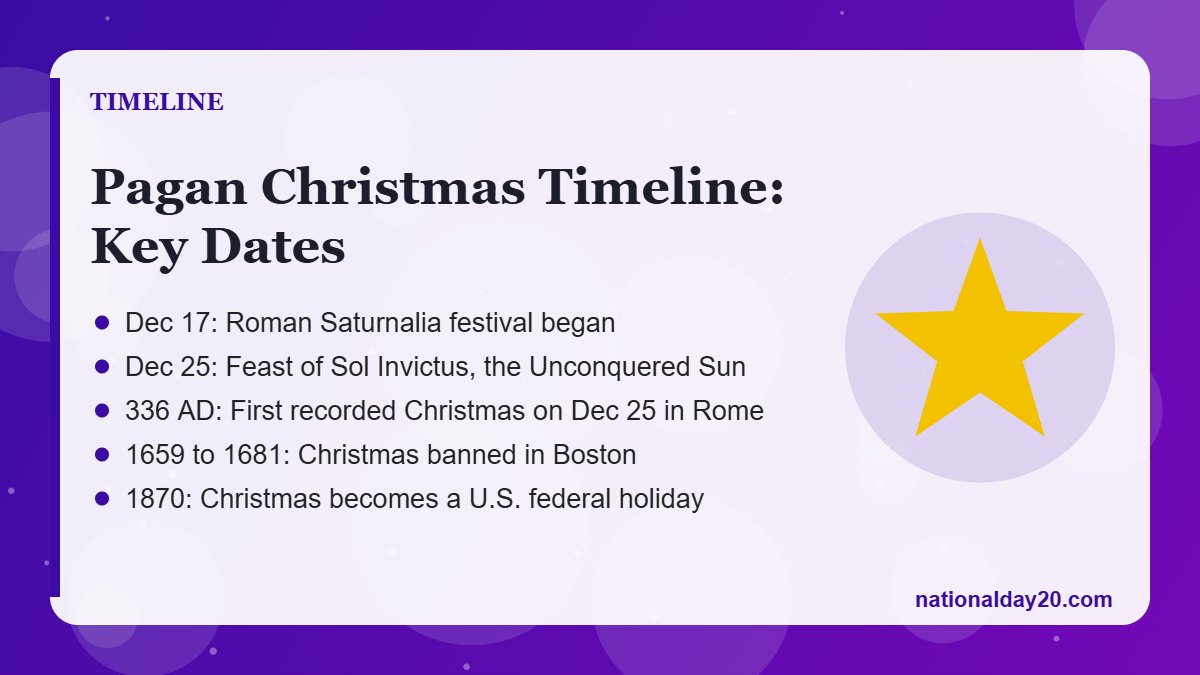
According to History.com and other historians, the earliest record of December 25 being marked as Christ’s birthday comes from a Roman calendar known as the Chronograph of 354. Historians generally date that part of it to the year 336, in Rome. By the late 300s, church leaders like Augustine and John Chrysostom were writing about December 25 as Christmas.
The word “Christmas” itself comes from “Christ’s Mass,” a church service.
The Pagan Festivals Around the Same Time
This is where the whole pagan Christmas argument comes from. Late December was already a busy time on the Roman calendar.
Saturnalia
Saturnalia was a Roman festival for Saturn, the god of agriculture. It started on December 17 and ran for about a week. It was a party: feasting, drinking, gift-giving, and a lot of rule-bending. Slaves and masters sometimes swapped roles for the day.
Sol Invictus
The “Unconquered Sun” was honored on December 25, right around the winter solstice, when the days start getting longer again. The cult of Sol Invictus was popular with Roman emperors in the late 200s.
Yule
Up in Germanic and Scandinavian Europe, people celebrated Yule in midwinter. Yule logs, evergreens, and feasting all show up there long before Christmas reached those areas.
So Did the Church Steal December 25?
This is the part people fight about. There are two main theories:
- The “borrowing” theory: The church picked December 25 to line up with Sol Invictus and Saturnalia, making it easier for Romans to switch over to Christianity without losing their winter party.
- The “calculation” theory: Some early Christians believed Jesus was conceived on the same date he died, which they put at March 25. Add nine months and you land on December 25. In this version, the date had nothing to do with pagans.
Historians still disagree. Honestly, it might be a bit of both.
Pagan Christmas Traditions We Still Use Today
Even if the date’s origin is debated, a lot of pagan Christmas decorations and customs clearly predate Christianity.
- Evergreens and wreaths: Ancient people brought green branches inside in winter as a sign that life would come back in spring.
- Yule logs: Straight from northern European midwinter festivals.
- Mistletoe: Linked to Celtic and Norse traditions long before anybody kissed under it at a Christmas party.
- Gift-giving and feasting: Both were big parts of Saturnalia.
- Lights and candles: Lighting fires and candles during the darkest days of the year shows up in tons of winter festivals.
The Christmas tree as we know it is actually newer. It came from Germany, where people decorated trees in their homes by the 1500s and 1600s, and it got popular in England and the U.S. in the 1800s.
When Christians Banned Pagan Christmas Celebrations
Here’s a fun one. Some Christians agreed with the “it’s too pagan” argument, and they did something about it.
English Puritans banned Christmas celebrations in the 1640s. In America, the Puritans in Massachusetts outlawed Christmas in Boston from 1659 to 1681. Celebrating could get you fined five shillings. They thought it was rowdy, unbiblical, and full of pagan leftovers.
Christmas didn’t become a federal holiday in the United States until 1870.
Is It Wrong for Christians to Celebrate Christmas?
That’s up to each person’s faith. Some groups, like Jehovah’s Witnesses, don’t celebrate Christmas, partly because of its pagan connections. Most Christian churches, Catholic and Protestant alike, don’t buy the pagan Christmas argument. Their view is that what matters is what you’re celebrating now, not where a decoration came from 2,000 years ago. A wreath on your door today doesn’t mean you’re worshiping Saturn.
The Bottom Line
Christmas is a Christian holiday with a pagan-flavored wrapping. The reason for the day, celebrating the birth of Jesus, is Christian. A lot of how we celebrate it, from the greenery to the feasting, goes back much further. So “pagan Christmas” is half right: pagan roots, Christian meaning. Both things can be true.
FAQ
Is pagan Christmas a real thing?
Partly. Pagan Christmas customs are real: the date may have been influenced by Roman festivals like Saturnalia and Sol Invictus, and many customs came from pagan winter traditions, but the holiday itself celebrates the birth of Jesus.
Was Jesus born on December 25?
Probably not. The Bible doesn’t give a date, and most scholars think we just don’t know.
What pagan holiday is on December 25?
The Roman feast of Sol Invictus, the “Unconquered Sun,” was celebrated on December 25. It’s one of the main reasons people bring up pagan Christmas origins. National Geographic has a good overview of how Christmas changed over the centuries.
Why did the Puritans ban Christmas?
They saw it as unbiblical and too connected to pagan customs and rowdy partying. Boston banned it from 1659 to 1681.
Not every family celebrates on December 25. See how Jewish Americans spend Christmas Day, or grab some ideas for what to ask for this Christmas.
